

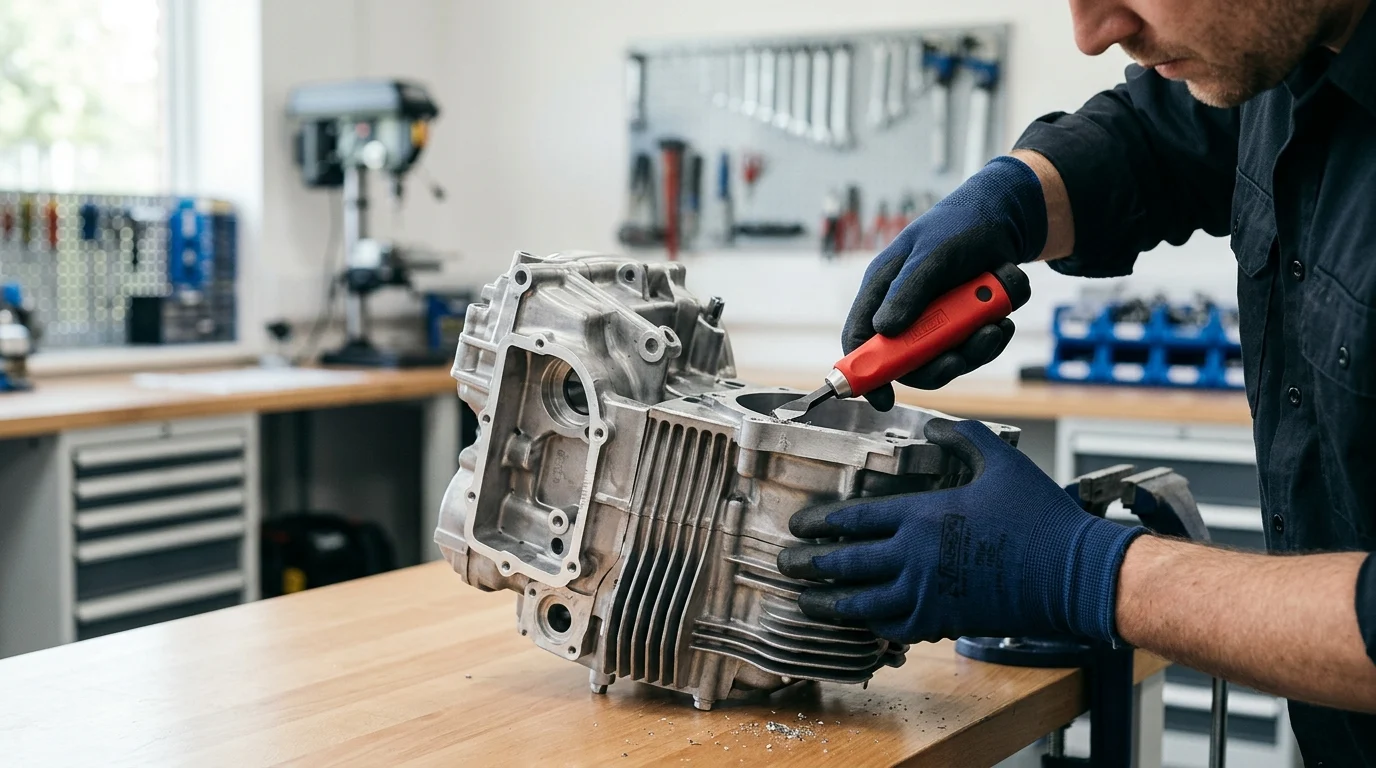


A motorcycle engine leaves little room for finishing errors: at 10,000–14,000 RPM, a microscopic burr can become a flow restriction, a fatigue crack starter, or a loose particle capable of damaging bearings and cylinder walls. Deburring engine components is therefore a precision reliability process, not a final-touch cosmetic operation. This article examines how burrs, flash, sharp edges, and EDM recast layers affect lubrication, airflow, fatigue strength, and service life. It also outlines practical edge-control expectations—such as typical 0.1–0.3 mm edge breaks—and explains why consistent, repeatable deburring is essential for high-performance motorcycle parts.
Why Deburring Matters for Motorcycle Engine Reliability
Motorcycle engines operate under extreme mechanical stress, frequently achieving rotational speeds between 10,000 and 14,000 RPM. At these velocities, the structural integrity and fluid dynamics of every internal component are tested to their limits. Motorcycle parts deburring is not merely an aesthetic finishing step; it is a critical manufacturing requirement that directly influences engine reliability, efficiency, and longevity. The presence of microscopic burrs, sharp edges, or manufacturing anomalies can compromise the entire powertrain system.
How burrs affect engine performance
The aerodynamic and hydrodynamic efficiency of a motorcycle engine relies heavily on the precise geometry of its internal passages. Burrs left behind from drilling, milling, or turning operations disrupt the laminar flow of essential fluids. For example, a burr protruding as little as 0.05 mm into a critical oil gallery can induce turbulence, restricting oil flow by up to 5%. This localized restriction starves downstream bearings of necessary lubrication, leading to elevated friction and thermal degradation. Similarly, in the intake and exhaust tracts, sharp edges and burrs can alter the air-fuel mixture dynamics, reducing volumetric efficiency and ultimately capping horsepower output.
Failure modes linked to poor deburring
Poor deburring practices are directly correlated with premature catastrophic engine failures. The most common failure mode is particulate contamination. When an engine undergoes thermal cycling and intense vibration, loosely attached burrs can fracture. A stray metal flake measuring just 50 microns can bypass secondary filtration, scoring cylinder walls or embedding itself into soft babbitt bearings. This results in spun bearings and seized connecting rods. Furthermore, sharp, un-radiused edges act as severe stress risers. Under high-cycle fatigue conditions, these micro-notches propagate into macroscopic cracks, leading to the structural failure of highly stressed components such as crankshafts and titanium connecting rods.
Key Deburring Requirements for Engine Components
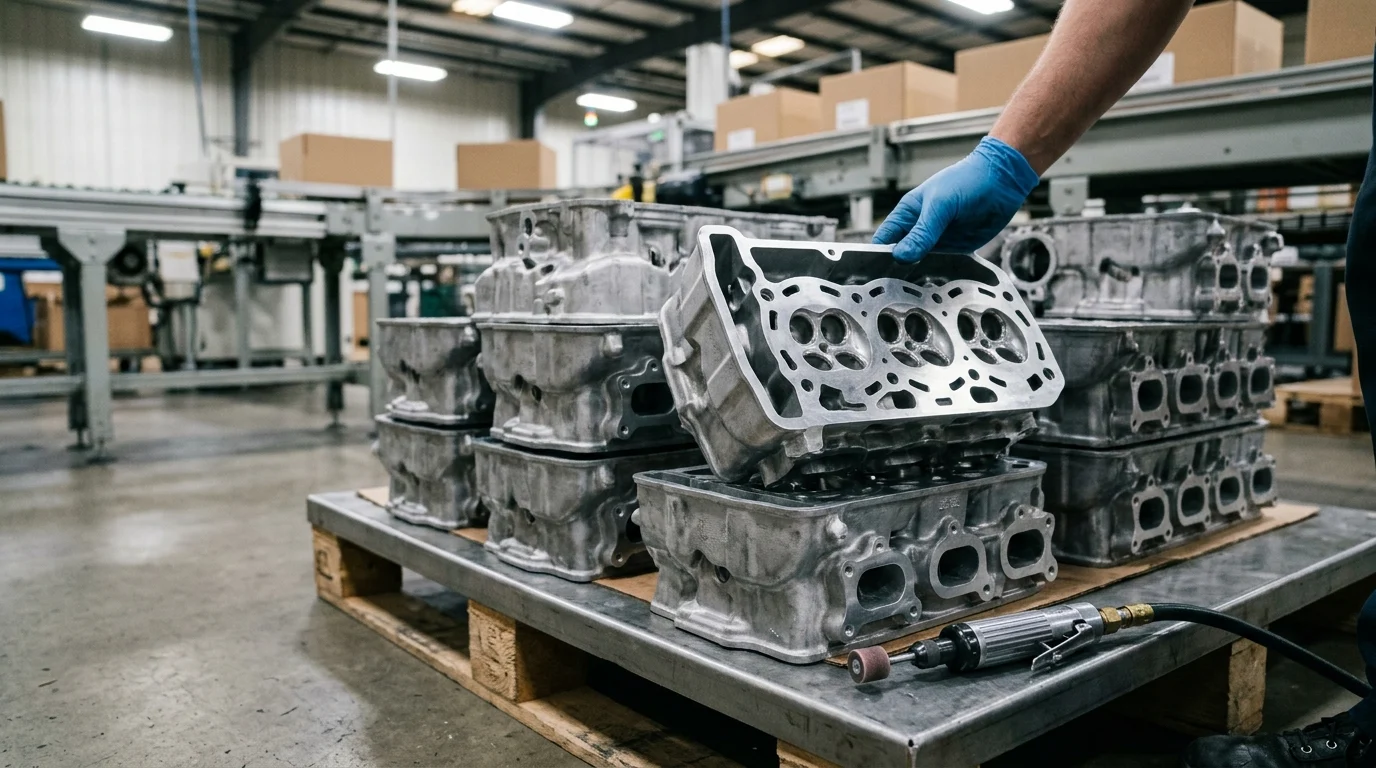
To guarantee the reliability of high-performance powertrains, engineering specifications mandate strict edge condition controls. The foundational requirement for engine components is the complete eradication of un-machined anomalies while maintaining dimensional tolerances, often necessitating an edge break radius between 0.1 mm and 0.3 mm depending on the component's operational load.
Burrs, sharp edges, flash, and recast layers
Different manufacturing processes impart distinct edge defects that must be mitigated. Mechanical machining generates traditional burrs (roll-over, Poisson, or breakout burrs) and sharp edges that require radiusing. Casting and forging processes often leave flash—excess material at the parting line—that must be ground away. Furthermore, components machined via Electrical Discharge Machining (EDM) develop a recast layer. This resolidified material is typically 10 to 20 microns thick, highly brittle, and prone to micro-cracking. Removing this recast layer alongside standard burrs is mandatory to restore the base material's fatigue strength.
| Defect Type | Origin Process | Typical Thickness/Height | Primary Risk |
|---|---|---|---|
| Roll-over Burr | Milling, Turning | 0.05 mm – 0.50 mm | Particulate detachment, flow restriction |
| Flash | Casting, Forging | 0.20 mm – 1.00 mm | Assembly interference, stress concentration |
| Recast Layer | EDM, Laser Cutting | 0.01 mm – 0.02 mm | Brittle fracture, micro-crack propagation |
| Sharp Edge | Shearing, Broaching | N/A (0 radius) | High-cycle fatigue failure |
Components requiring tight deburring control
Not all motorcycle engine parts require the same level of deburring scrutiny. Components subjected to continuous friction, high pressure, or reciprocating mass demand the tightest edge controls. Crankcases require pristine mating surfaces to prevent gasket failure and oil leaks. Connecting rods, particularly at the big end, require precise edge radiusing to prevent stress fractures under immense tensile loads. Camshaft lobes and valve bodies also demand microscopic deburring to ensure smooth actuation and prevent the premature wear of valve seals and lifters.
Material, geometry, and heat-treatment factors
The approach to deburring is heavily dictated by the alloy's metallurgical properties and the part's geometry. Ductile materials like A356 cast aluminum tend to form large, gummy burrs that fold over rather than shear off, requiring specific abrasive media. Conversely, forged steel (e.g., 4340) or titanium alloys produce smaller, harder burrs. Heat treatment further complicates the process; if a transmission gear is case-hardened to 60 HRC before deburring, the burrs become exceptionally brittle. While this can make them easier to snap off, it also increases the risk of leaving a jagged microscopic root, necessitating advanced chemical or thermal removal methods rather than simple mechanical tumbling.
Best Deburring Methods for Motorcycle Engine Parts
Selecting the optimal deburring method requires balancing the material properties of the motorcycle component against the geometric complexity of the defect. Modern manufacturing utilizes a spectrum of deburring technologies, ranging from traditional abrasive friction to advanced molecular dissolution, to achieve the necessary edge conditions.
Manual, mechanical, thermal, and electrochemical options
Manual deburring using rotary tools remains common for low-volume or prototype runs, but it lacks the repeatability required for mass production. Mechanical options like vibratory finishing and centrifugal barrel tumbling are industry standards for exterior surfaces, utilizing ceramic or plastic media to abrade edges. For internal or hard-to-reach areas, the Thermal Energy Method (TEM) is highly effective. TEM utilizes a combustible gas mixture ignited in a pressurized chamber, reaching temperatures of 3,300°C for roughly 20 milliseconds—incinerating micro-burrs instantly without altering the bulk part temperature. Alternatively, Electrochemical Machining (ECM) dissolves burrs at an atomic level through anodic dissolution, providing unparalleled precision for high-value alloys.
Process capability and edge-control comparison
Process capability varies significantly across these methods, particularly regarding edge-control tolerances and surface finish impacts. Mechanical tumbling provides an edge radius tolerance of approximately ±0.1 mm, which is sufficient for exterior crankcase edges but inadequate for precision fuel injection ports. ECM, by contrast, can control edge radii down to ±0.01 mm without inducing any mechanical or thermal stress into the component.
| Deburring Method | Edge Radius Tolerance | Mechanical Stress Induced | Avg. Cost per Part (High Vol) | Best For |
|---|---|---|---|---|
| Vibratory Tumbling | ± 0.10 mm | Low | $0.05 – $0.15 | Exterior castings, gears |
| Thermal Energy (TEM) | ± 0.05 mm | None (Thermal only) | $0.20 – $0.50 | Internal intersecting holes |
| Electrochemical (ECM) | ± 0.01 mm | None | $0.50 – $1.20 | Aerospace-grade engine parts |
| Abrasive Flow (AFM) | ± 0.02 mm | Moderate | $0.80 – $1.50 | Complex internal fluid galleries |
Applications for complex engine geometries
Complex engine geometries, such as cross-drilled oil passages in crankshafts or the internal cooling jackets of cylinder heads, present unique challenges. Mechanical media cannot reliably reach deep intersections, risking media lodgment which can be fatal to an engine. In these applications, Abrasive Flow Machining (AFM)—which forces a viscoelastic abrasive polymer through the internal cavities—or TEM are the preferred solutions. These methods guarantee that intersecting blind holes and deep galleries are completely free of obstruction, ensuring fluid dynamics meet the original engineering intent.
How to Control Deburring Quality
Implementing a rigorous deburring process is only half the equation; establishing robust quality control mechanisms ensures that the edge conditions remain consistent across production batches. Without strict metrology and standardized inspection protocols, deburring can easily drift out of tolerance, leading to compromised engine performance.
Process steps from incoming inspection to final cleaning
Quality control in deburring is a multi-stage workflow. It begins with incoming inspection of the machined parts; if the upstream machining process allows tool wear to exceed limits, the resulting burr may be too thick for the established deburring cycle to remove. The core deburring process must be followed by rigorous post-cleaning. Mechanical and chemical deburring methods leave behind abrasive media, carbon soot, or electrolyte residues. Implementing ultrasonic cleaning stations operating at 40 kHz is standard practice to dislodge particulate matter from blind holes before the parts move to final assembly.
Inspection methods for edge and surface quality
Validating edge and surface quality requires specialized metrology equipment. Visual inspection is insufficient for micro-burrs. Quality engineers utilize articulating borescopes to inspect internal cross-holes for residual burrs or lodged media. For external edges, tactile profilometry and laser scanning microscopes are deployed to measure the exact radius of the edge break, capable of resolving profiles down to 0.01 mm. Optical comparators are also frequently used to verify that the deburring process has not inadvertently altered the critical dimensions of the component's primary geometry.
Linking deburring specifications to quality standards
To ensure global consistency, motorcycle manufacturers link their internal edge specifications to international standards. Referencing bodies like the ISO standards framework—specifically ISO 13715 for technical product documentation—allows engineers to mathematically define the state of an edge. By specifying a maximum allowable burr height or a precise negative edge break (e.g., -0.2 mm), suppliers and OEMs have a unified, quantifiable target that removes subjective interpretation from the quality control process.
How to Choose the Right Deburring Strategy
Choosing the right deburring strategy involves balancing technical requirements with economic realities. Manufacturers must align their chosen deburring technology with their production scale, capital availability, and supply chain logistics to maintain profitability without sacrificing engine reliability.
In-house versus outsourced deburring
The primary strategic decision is whether to keep deburring operations in-house or to outsource them to specialized finishing facilities. In-house deburring offers tighter control over production schedules and immediate feedback loops to the machining department. However, advanced technologies require significant capital expenditure (CapEx). Outsourcing shifts this CapEx to operational expenditure (OpEx), granting access to specialized processes like ECM or TEM without the upfront machinery investment, which is highly advantageous for prototype runs or low-volume boutique motorcycle manufacturing.
Total cost and production-volume considerations
Total cost of ownership and production volumes are the ultimate arbiters of this decision. A baseline vibratory finishing setup may cost $15,000, making it accessible for almost any in-house operation. Conversely, a fully automated TEM or ECM cell can require a capital investment exceeding $250,000. Industry consensus suggests that a production volume threshold of greater than 50,000 units per year is typically required to justify the ROI on automated, high-precision in-house deburring systems. When evaluating these costs, manufacturers must also factor in global supply chain economic data to account for regional energy costs, labor rates, and environmental compliance expenses related to waste disposal.
Decision framework for safe process selection
To navigate these variables, production managers should utilize a structured decision framework. First, categorize the component by material hardness and geometric complexity (e.g., external edges vs. internal cross-holes). Second, define the non-negotiable edge tolerances required for engine reliability. Finally, cross-reference these technical constraints with annual volume projections. If the part features internal intersecting holes in a titanium alloy and volume is low, outsourced TEM is the safest, most cost-effective path. If the part is a high-volume aluminum crankcase, investing in an in-house robotic routing or vibratory system will yield the best long-term margins.
Key Takeaways
- Specify deburring as a reliability requirement, not a cosmetic step, because motorcycle engines often operate at 10,000–14,000 RPM.
- Control oil-gallery burrs aggressively, since a 0.05 mm protrusion can disturb flow and restrict lubrication to downstream bearings.
- Remove loose burrs and particles before assembly, because a 50-micron metal flake can score cylinders or embed in soft bearing materials.
- Apply edge break radii of roughly 0.1 mm to 0.3 mm where specified to reduce stress risers without compromising component dimensions.
- Eliminate EDM recast layers of about 10–20 microns when present to restore fatigue strength and reduce micro-crack risk.
- Use repeatable robotic deburring or grinding processes for complex parts where consistent edge quality and dimensional control are required.
Frequently Asked Questions
Why is deburring critical for motorcycle engine components?
Motorcycle engines can run at 10,000–14,000 RPM, so tiny burrs can disrupt oil flow, create stress risers, or break loose as damaging particles. Proper deburring improves lubrication, fatigue strength, and long-term engine reliability.
How small can a burr be and still cause engine problems?
A burr protruding only 0.05 mm into an oil gallery can create turbulence and restrict oil flow. Even a 50-micron metal flake may score cylinder walls or damage bearings if it breaks free.
Which motorcycle engine parts need the most careful deburring?
Critical parts include crankshafts, connecting rods, cylinder heads, oil galleries, intake and exhaust passages, gear components, and cast or forged housings. Any surface exposed to oil flow, combustion flow, or high-cycle fatigue needs controlled edges.
What edge radius is commonly required after deburring?
Many engine components require an edge break radius of about 0.1 mm to 0.3 mm, depending on load, material, and drawing specifications. The goal is to remove sharp edges without altering functional dimensions.
What risks come from poor deburring in high-performance engines?
Poor deburring can cause oil starvation, bearing damage, cylinder scoring, crack initiation, reduced airflow efficiency, and premature component failure. These risks increase sharply under vibration, heat cycling, and high RPM operation.